How to Choose the Right Sewing Needle for Different Fabrics
A comprehensive guide to sewing needle types, size numbering systems, point geometries, and pairing needles accurately with delicate silks, cottons, knits, and heavy denim.
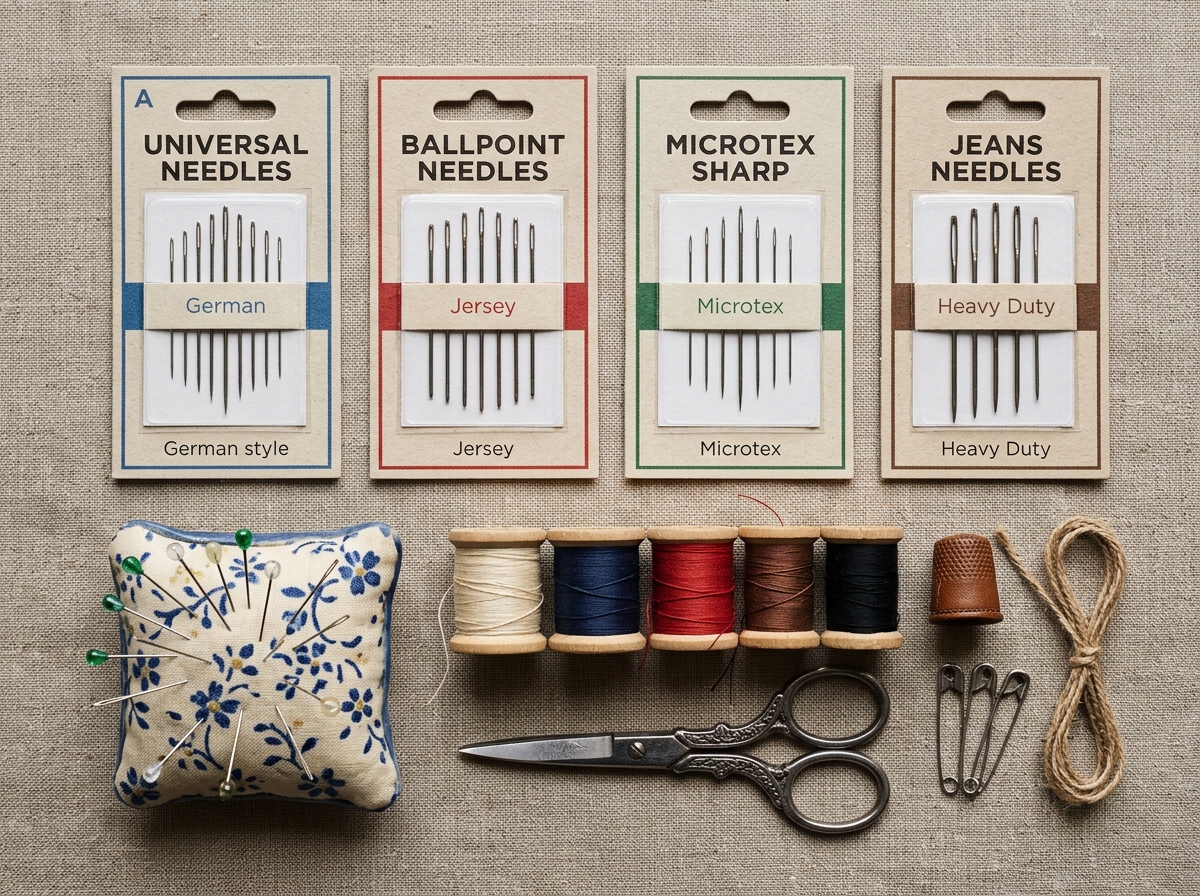
Nothing derails a sewing or mending project faster than using the wrong needle. A needle that is too blunt can snag delicate knit yarns, while a needle that is too thick leaves permanent puncture holes in silk or waterproof fabrics. Yet many sewists keep the same generic needle in their kit for years, wondering why their machine skips stitches or puckers lightweight cotton.
Understanding needle types and sizing is one of the highest-leverage fundamentals in sewing. In this reference guide, you will learn how the dual European/American sizing system works, how different needle points interact with textile structures, and how to spot the early warning signs of a dull or mismatched needle.
Materials Required
- Needle assortment pack: Universal, Ballpoint (Jersey), Microtex (Sharp), and Jeans/Denim needles.
- Various fabric swatches: Cotton lawn, jersey knit, denim, and linen to test stitch formation.
- Needle pincushion with emery strawberry: For storage and cleaning needle shafts.
Tools Needed
- Good lighting or magnifying loupe: Helpful for inspecting tiny needle tips visually under direct light.
- Scrap fabric test strip: To test stitch penetration before sewing your actual garment.
Step-by-Step Instructions
Master the Size Scale (Weight Compatibility)
Needle sizes range from fine (60/8) to heavy-duty (120/19). For sheer fabrics like chiffon and voile, use 60/8 or 70/10. For standard shirts and quilting cottons, use 80/12. For medium suitings and linens, use 90/14. For heavy canvas, denim, and upholstery, use 100/16 or 110/18.
Universal Needles (Everyday Wovens)
Universal needles feature a slightly rounded point that can pierce through general woven fabrics and stable knits. They are the versatile workhorse for cotton quilting, shirting, linens, and light synthetics.
Ballpoint & Stretch Needles (Knits & Spandex)
Ballpoint needles have a rounded tip that slides between the knitted yarn loops rather than piercing or cutting through them. Stretch needles feature a deeper scarf (the groove above the eye) and special coating to prevent skipped stitches on high-elasticity fabrics like swimwear or athletic knits.
Microtex / Sharp Needles (Silks & Precision Wovens)
Microtex needles have a very slim, acute point that pierces clean, precise holes. They produce perfectly straight topstitching on tightly woven fabrics like microfibers, silk taffeta, poplin, and artificial leathers.
Jeans / Denim Needles (Dense & Heavy Weaves)
Jeans needles have a reinforced shaft to resist bending or deflecting when penetrating thick layered seams, combined with a sharp point that pushes through tough twill weaves without dulling.
Inspect and Replace Needles Regularly
Sewing machine needles experience rapid wear: a reasonable guideline is to change machine needles after every 8 to 12 hours of active sewing or after completing a full garment. Hand needles last considerably longer, but will eventually develop burrs. Test by sewing on a scrap piece of your project fabric and listening for a popping sound, or inspecting the tip under bright light.
Common Mistakes & Solutions
Using a sharp needle on knit fabrics
Why it happens: Cuts through the knit yarn fibers, causing ladder runs and holes along the seam after a few washes.
Correction: Always switch to a ballpoint or stretch needle for knit garments.
Sewing thick denim with a standard universal size 70 or 80 needle
Why it happens: The slender needle flexes on thick seams, strikes the needle plate, and snaps violently.
Correction: Use a reinforced Jeans/Denim needle in size 90/14 or 100/16.
Keeping a needle until it visibly breaks
Why it happens: Dull needles punch rather than pierce, creating chewed fabric, thread shredding, and loud thumping noises.
Correction: Change needles regularly based on project density and sound.
Frequently Asked Questions
What do the two numbers like 90/14 on a needle package mean?
The first number (90) is European metric sizing, representing blade diameter in hundredths of a millimeter (0.90 mm). The second number (14) is American sizing. They represent the exact same physical needle dimensions.
How do I know if my sewing machine needle is dull or bent?
Listen to the sound of your machine: a rhythmic "popping" or "thumping" sound as the needle penetrates the fabric indicates a dull point. Other signs include skipped stitches, shredded thread, or pulled fabric threads.
Can I use sewing machine needles for hand sewing?
No. Sewing machine needles have a flat shank side and their eye is positioned at the point. Hand sewing needles have their eye at the top opposite the point and are balanced for manual grip and thimble control.